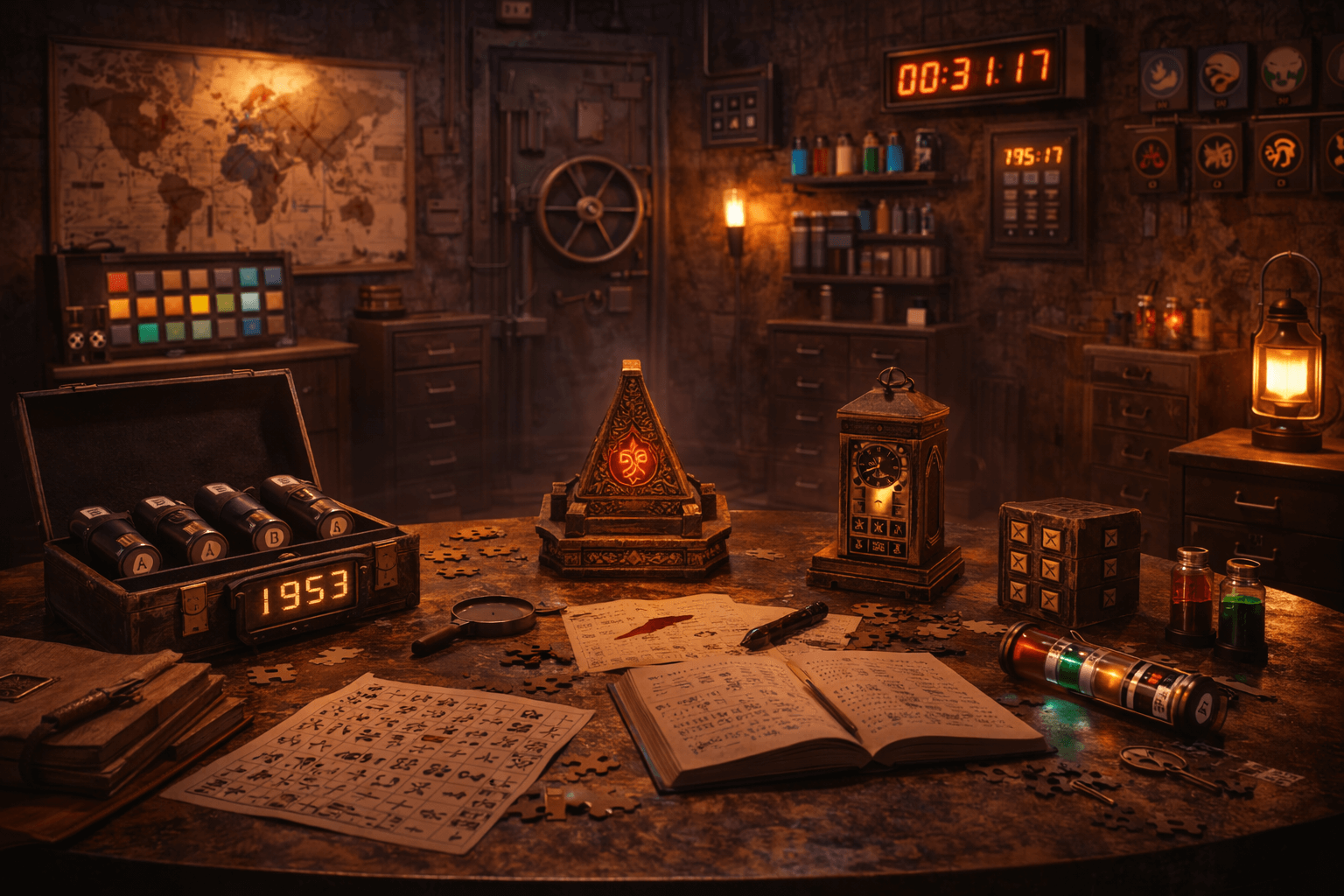
Failed an Escape Room in Sydney? Here’s the Difference Between ‘Hard’ and ‘Badly Designed’
The clock strikes zero, the door opens up, and there comes your game master explaining those puzzles which you didn’t solve. There are basically two responses from the group in such cases. Either there is an exasperated groan that it was so obvious, or there comes a collective “How do you expect anyone to figure that out?”
Both can be considered as a loss, but each conveys a completely different message. In the former case, there is a room that has successfully bested you. In the latter case, it means that the escape room Sydney had some design flaws which were impossible to figure out even with collaboration. Knowing the difference helps you learn from your mistakes.
What real difficulty looks like
Escape room difficulty is complex. An escape room puzzle could require you to connect clues that are in different corners, translate one symbol system into another, and work on multiple clues at the same time. Difficulty arises from complexity, but also from teamwork.
Fairness is the key aspect of an escape room. Everything you need for solving the riddles is available in the room. The logic works throughout the whole process from the beginning until the very end. Puzzles in good escape rooms introduce rules in the beginning and test you in the end. A fair challenge keeps a team leaning in because the answer always feels reachable, and the reveal lands as ‘we should have seen that’.
Signs of a badly built room
Poor design leaves fingerprints. One of the more common types is outside knowledge. This involves the game assuming you know Morse code or a fact that is not included anywhere in the escape room itself. Another frequent type would be logic jumps where there is some correlation between something in the room and another object.
Other flaws are mechanical or structural. A magnetic lock might refuse to release with the correct object in place. A four-digit code might give no signal about digit order. A key might sit inside an air vent with no clue pointing there. Each one turns problem-solving into guesswork.
Red herrings matter too. One deliberate distraction is fair play, but a room crowded with props that look important and lead nowhere is a failure of escape room design. Teams feel it quickly. Conversation stalls, players drift apart and someone starts trying padlock combinations at random.
The hindsight test
The fairest way to judge a loss is to replay the walkthrough. For every puzzle you missed, ask three questions. Was everything we needed physically in the room? Did the answer follow a rule the room had already shown us? Would a sharper, better-organised team have reached it without reading the designer’s mind?
But when they all come out to be yes, then you have been treated fairly. When it consistently comes to no, then the problem is with the escape room itself and not your team. Good escape room puzzles always fare well with this criteria and hence lose by a close margin in a good room always calls for a rematch.
Where hints fit in
Most rooms are paced on the expectation that teams will stall. The role of a good gamemaster lies in providing subtle direction to the object or concept that is to be found while leaving out the solution itself. It is normal to require multiple hints when the level of difficulty of an escape room is high.
The pattern matters more than the count. If each hint made you think ‘that’s clever, we nearly had it’, the room was doing its job. If each one revealed something you couldn’t have known, the hints were patching holes in the build. Ask at check-in how hints work for your escape room Sydney session, since policies vary between venues.
Choosing your next room
Difficulty and fear are separate scales, and mixing them up is a common booking mistake. At The Great Escape on Cope Street in Redfern, the booking page gives each room its own difficulty and fear factor rating. A Silent Place sits at five out of five on both, so groups wanting a challenge without the scares can compare King Arthur and Zumunji on the same two scales.
Read escape room difficulty as a promise about depth and pace, then match it to your group. The venue is a short walk from Redfern Station, an easy trip for after-work teams from the CBD. For a team whose last loss felt unearned, a well-built escape room Sydney experience is the cleanest way to find out whether the problem was the team or the room.
FAQs
1. Does failing to escape mean the room was too hard, or just poorly designed?
Failing alone proves neither. If every answer relied on information inside the room and logic it had already taught you, the room was hard. Constant guesswork points to poor design.
2. How can you tell if an escape room’s puzzles are fair?
Balanced escape room puzzles rely on elements that are available within the room, and have logical consistency. In addition, the solution should feel obvious after its revelation.
3. Is it normal to need a lot of hints to get through a room?
Yes, especially in rooms rated highly for difficulty. Hints are built into the pacing. What matters is whether each hint nudged your thinking or revealed information the room never provided.